Mostrar mensagens com a etiqueta correspondência. Mostrar todas as mensagens

8 de outubro de 2012

Isaac Asimov, Gene Roddenberry e o rigor científico de Star Trek

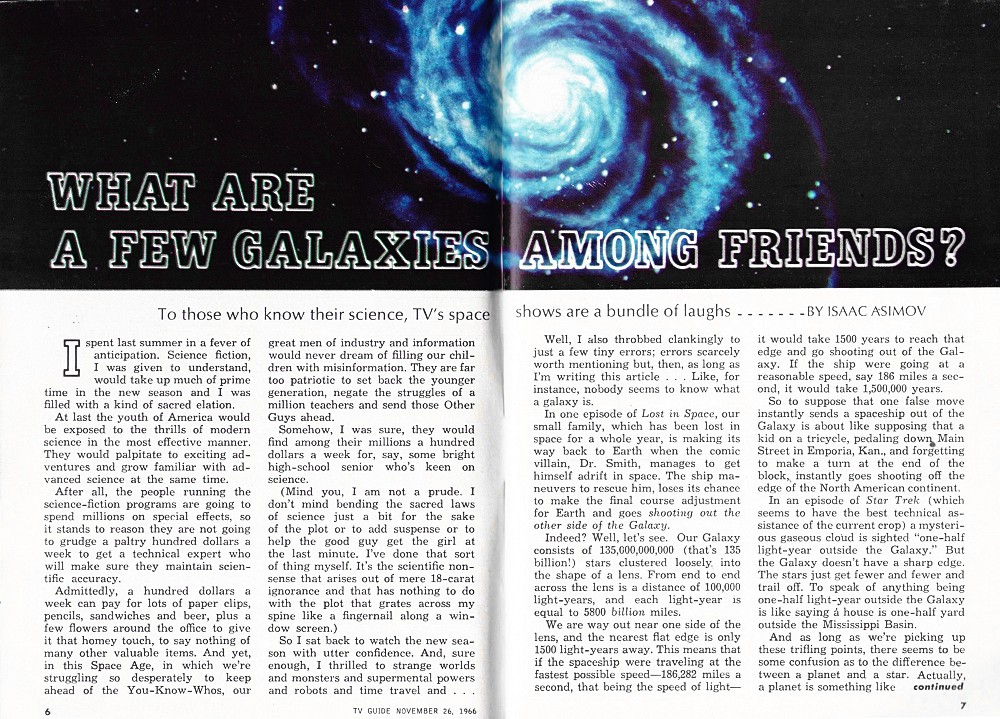
Voltamos hoje ao Letters of Note (um pequeno baú com muitos tesouros) para falar da ficção científica televisiva. Produzir uma série do género tem muito que se lhe diga - sobretudo quando a coisa estava ainda a dar os primeiros passos, na década de 60. Dois meses volvidos sobre a estreia da primeira, hoje lendária, temporada de Star Trek, Isaac Asimov - ainda por cima - publicou um artigo na revista TV Guide intitulado What are a few galaxies among friends?, criticando de forma mordaz e cientificamente precisa a falta de rigor científico presente na ficção científica televisiva da época, com exemplos de Lost in Space e Star Trek. O artigo pode ser lido na íntegra aqui, e contém pérolas como esta:

In an episode of Star Trek (which seems to have the best technical assistance of the current crop) a mysterious gaseous cloud is sighted "one-half light-year outside the Galaxy." But the Galaxy doesn't have a sharp edge. The stars just get fewer and fewer and trail off. To speak of anything being one-half light-year outside the Galaxy is like saying a house is one-half yard outside the Mississippi Basin. 

Se isto não é um headshot, não sei bem o que será. Adiante. O artigo, como seria de esperar, foi lido por imensa gente - entre as quais Gene Roddenberry, criador de Star Trek, que decidiu responder a Asimov numa carta que pode ser lida aqui, e da qual cito alguns excertos:

Enjoyed it [o artigo de Asimov na TV Guide] as I enjoy all your writing. And it will serve as a handy reference to those of our Star Trek writers who do not have a SF background. Although, to be perfectly honest, those with SF background and experience tend to make the same mistakes. I've found that the best SF writing is no guarantee of science accuracy.

Roddenberry, como se pode ver, também tinha chumbo grosso. E continua:

A person should get his facts straight when writing anything. So, as much as I enjoyed your article, I am haunted by this need to write you with the suggestion that some of your facts were not straight. And, just as a writer writing about science should know what a galaxy is, a writer writing about television has an obligation to acquaint himself with pertinent aspects of that field. In all friendliness, and with sincere thanks for the hundreds of wonderful hours of reading you have given me, it does seem to me that your article overlooked entirely the practical, factual and scientific problems involved in getting a television show on the air and keeping it there.

É certo que a desculpa pode ser um tanto ou quanto esfarrapada, mas toca num ponto fundamental: a ficção científica na televisão (e, acrescento, no cinema) é muitas vezes uma espécie de "arte do possível" - como tal, muitas imprecisões acabam por ser necessidades incontornáveis do processo de produção (gravidade em naves espaciais, por exemplo).

Quoting Ted Sturgeon who made his first script attempt with us (and now seems firmly established as a contributor to good television), getting Star Trek on the air was impossible, putting out a program like this on a TV budget is impossible, reaching the necessary mass audience without alienating the select SF audience is impossible, not succumbing to network pressure to "juvenilize" the show is impossible, keeping it on the air is impossible. We've done all of these things. Perhaps someone else could have done it better, but no one else did.

É interessante notar a falta de "temor reverencial" de Roddenberry face a Asimov - que à época era um cientista de renome e dos maiores nomes da ficção científica literária. A história, contudo, acabou bem. Roddenberry e Asimov continuaram a trocar correspondência, ficaram amigos e Asimov acabou mesmo como consultor da série (e ajudou a resolver alguns problemas). O artigo no Letters of Note inclui mais algumas missivas trocadas entre ambos que merecem leitura. 


3 de outubro de 2012

Good guy Heinlein

No io9, recomendo a leitura deste interessante artigo sobre a ajuda (de longa distância, note-se) que, em tempos, Robert A. Heinlein deu a Theodore Sturgeon para este superar o seu “writer’s block”. Na Worldcon de 1962, Sturgeon contou o episódio da carta que enviara a Heinlein, e da resposta que recebeu - com 26 ideias para histórias (e um cheque de 100 dólares). Essa missiva de resposta a Sturgeon pode - e deve - agora ser lida no site Letters of Note. Para todos os efeitos, não foi só a imaginação e a capacidade de escrita excepcionais de Heinlein que o tornaram num dos grandes escritores que o género da ficção científica conheceu, mas também a sua generosidade para com os colegas (Philip K. Dick que o diga). Abaixo, alguns excertos seleccionados da carta de Heinlein a Sturgeon:


Almost all writers need cross-pollenation—myself most certainly! (I am at present stuck on p.148 of the best set-up for a novel I ever had in my life and I cannot get the Goddam thing to gel!) The M.L.S. [Mañana Literary Society] used to give ideas such a kicking around that a man went out of there with notes enough for three months; when Jack Williams, Anthony Boucher, Cleve Cartmill, Mick McComas, and several others all got to snarling over the same bone, something had to give. 

(...) 

But I will do the best I can at this distance. I must say that I am flattered at the request. To have the incomparable and always scintillating Sturgeon ask for ideas is like having the Pacific Ocean ask one to pee in it. 

(...) 

Mmm...Sturgeonish ideas—Well, here's one that might be Campbellish: a society where there are no criminal offences, just civil offences, i.e., there is a price on everything, you can look it up in the catalog and pay the price. You want to shoot your neighbor? Go ahead and shoot the bastard. He has a definite economic rating; deposit the money with the local clearing house within 24 hrs.; they will pay the widow. Morality would consist in not trying to get away with anything without paying for it. Good manners would consist in so behaving that no one would be willing to pay your listed price to kill you. Of course if your valuation is low and your manners are crude, your survival probabilities are low, too.  

(...) 

We know very little about multiple personality, despite the many case records. Suppose a hypnoanalyst makes a deep investigation into a schizoid...and comes up with with the fact that it is a separate and non-crazy personality in the body, distinct from the nominal one, and that this new personality is a refugee from (say) 2100 A.D., when conditions are so intolerable that escape into another body and another time (even this period) is to be preferred, even at the expense of living more or less helplessly in another man's body. 

(...) 

What is a personality? A memory track? A set of evaluations? A set of habit patterns? What happens to a soul in a transorbital lobotomy? Is it murder to kill a man's personality, sick though it may be, in order to make his body a bit more tractable for ward nurses and relatives? 

(...) 

You could have a hell of a hassle in a society in which there were a group, large or small, of illuminati who really do know what happens after death (as compared with the fakers we now have) and who in consequence have different motivations and different purposes from the others who are the way we are now. Just for a touch, they might try a man in absentia for suiciding to avoid his obligations...then maybe have some one else suicide to go after him and carry out the sentence. (But hell, Bill, I don't have to tell you—just some of your usual hoke that Dick Burbage can get his teeth into. We start rehearsals Wednesday. Quote and unquote). 

(...) 

This guy sells soap and cosmetics, door to door like the Fuller Brush man. She tries their beauty soap; she becomes beautiful. So she tries their vanishing cream... 

(...) 


Fonte: io9, Letters of Note